
Padmanabhaswamy Temple history, from the Alwars to the Supreme Court
The shrine is named in Tamil hymns from the 8th century, but the granite temple standing in East Fort today was raised in 1733. Seventeen years later a king handed his entire kingdom to the deity, and that single act explains why this became the richest place of worship in the world.
Last checked 15 August 2026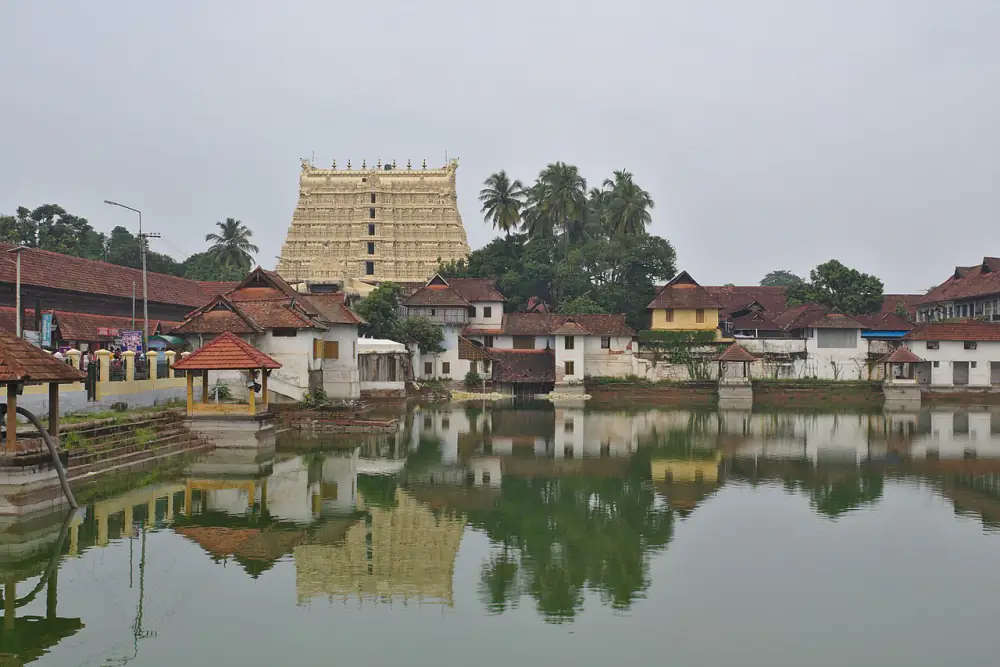
Twelve centuries of record, in four dates that matter
Most of what visitors want to know sits in these four moments. Everything else is detail hanging off them, and the fourth is the only one that happened inside living memory.
The king who gave away an entire kingdom
On 3 January 1750, Marthanda Varma placed his sword before the deity and surrendered Travancore to Sree Padmanabhaswamy. He did not abdicate. He became Padmanabhadasa, the servant who governs on the Lord’s behalf, and every ruler after him took the same title.
From that day the state treasury and the temple treasury were one thing. Tribute, war spoils and trade income flowed to the deity, and none of it was ever taken back out.
Some of this is documented, and some of it is a very good story
Both columns matter. The left is what state papers and court records confirm. The right is temple tradition, repeated for centuries and impossible to verify.
What the records confirm
- The 1733 rebuilding in granite under Marthanda Varma, recorded in Travancore state papers
- The Thrippadidanam of 1750, documented in the royal chronicles
- The 2011 vault inventory, carried out under Supreme Court supervision
- The 2020 judgment restoring administration to the Travancore royal family
What is temple legend
- That the temple was founded by the sage Divakara Muni after a vision of Vishnu
- That Vault B is guarded by serpents and cannot be opened without ruin
- That the idol was assembled in a single night by 4,000 workmen
- That an underground passage runs from the sanctum to the Kuthiramalika Palace
Nothing in the right hand column is dismissed by the temple. These accounts are part of how the shrine understands itself, and the sealed state of Vault B rests on exactly this tradition rather than on any legal barrier.
Twelve thousand stones from a river in Nepal
The reclining figure is about 18 feet long and is not carved from a single block. It is assembled from 12,008 saligramams, fossil stones collected from the bed of the Gandaki river in Nepal and carried south by elephant.
They are bound with katusarkara yogam, a hard plaster of herbs and ayurvedic materials containing no metal. Because of that binding the idol is never bathed with water. It is anointed instead, which is why the Abhishekam that closes the sanctum at 4:45 AM runs for nearly two hours.
- Ananthasayanam posture, reclining on the coiled serpent Anantha
- The right hand rests over a Shiva lingam, so two gods share one figure
- Brahma rises on a lotus from the navel, completing the three
- Sridevi and Bhudevi stand at the feet with the sages Bhrigu and Markandeya
Padmanabhaswamy Temple photos from a century ago
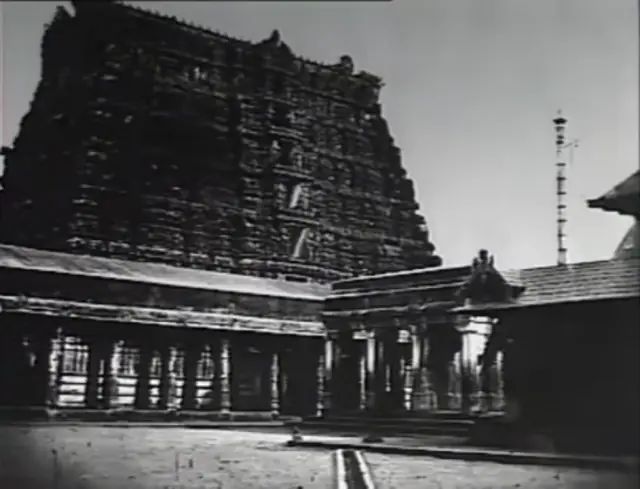
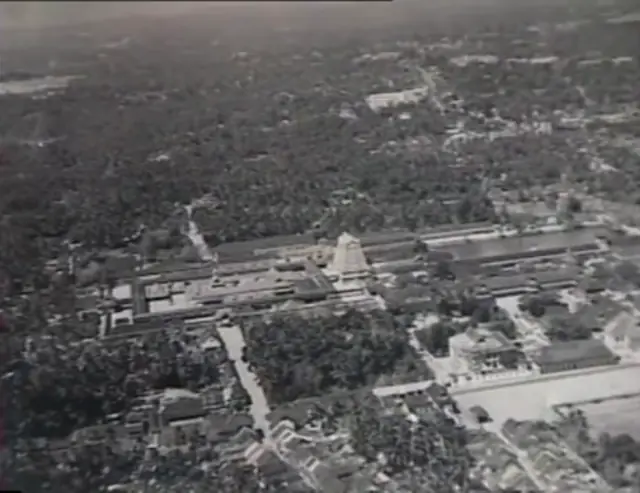
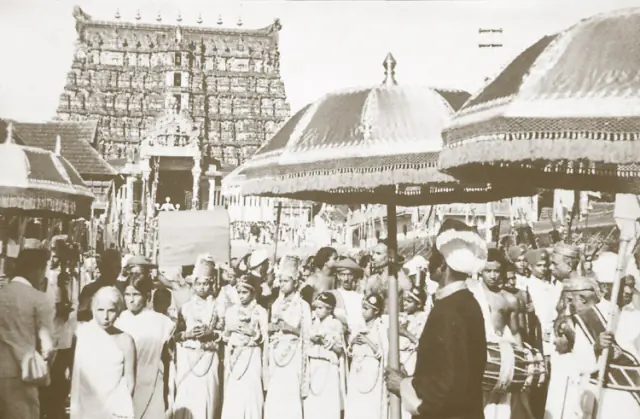
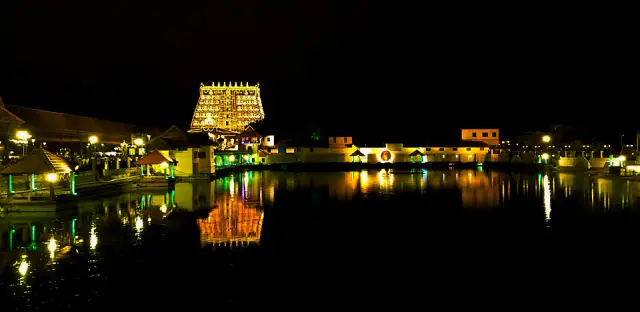
Photography is not allowed past the entrance today, so the archive is what survives. These images are in the public domain or freely licensed, and show the temple much as it looks now. The gopuram, the tank and the crowd at the gate have barely changed in a century.
How a shrine in Ananthapuram became the wealthiest temple on earth
The short version is one king and one decision. The longer version runs through four stages, each of which added something the next one built on.
Before the kingdom
- The Alwar saints name Ananthapuram in the Divya Prabandham, placing an active shrine here by the 8th century.
- The town takes its name from the deity. Thiruvananthapuram means the town of Anantha, the serpent the deity reclines on.
- Earlier structures were timber and laterite. Nothing of them survives above ground.
- Records from the Ay dynasty and later the Venad rulers show continuous patronage long before Travancore existed as a kingdom.
Marthanda Varma rebuilds
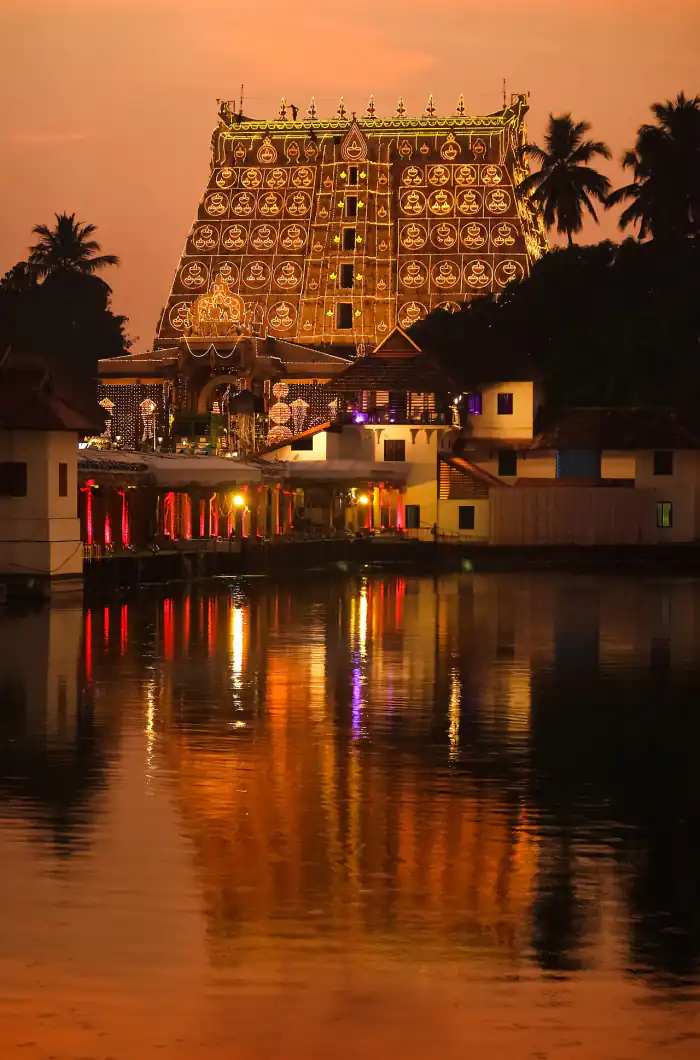
- Between 1729 and 1733 the temple is rebuilt in granite, with the seven storey gopuram and the corridor of carved pillars.
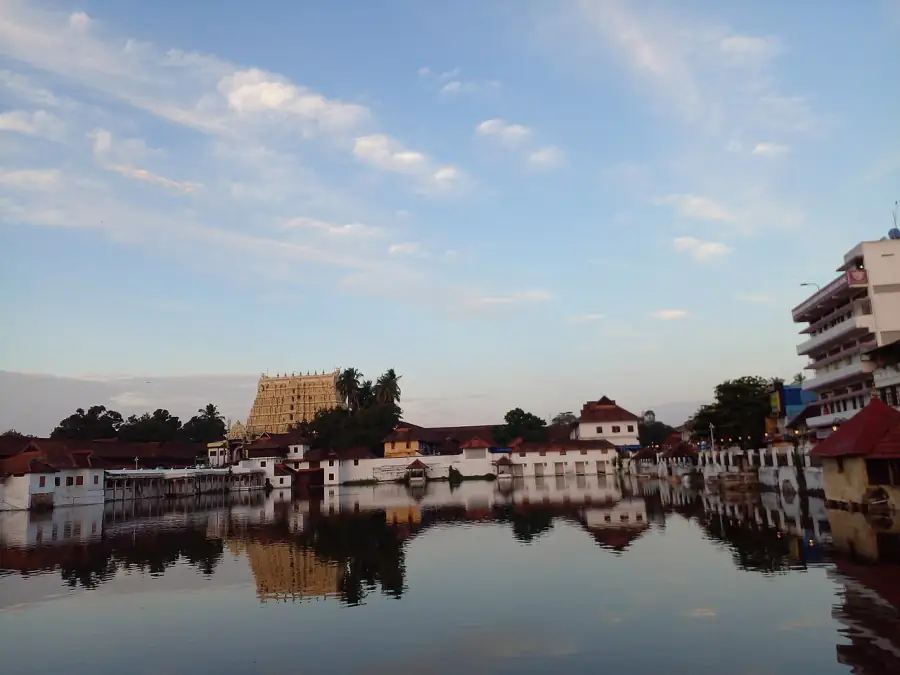
- The Padma Theertham tank in front of the temple is cut at the same time.
- The idol is reconsecrated using the saligramams brought from the Gandaki river.
- The Ottakkal Mandapam, a hall cut from a single slab of granite, is laid in front of the sanctum during the same works.
The wealth accumulates
After the Thrippadidanam of 1750 there is no line between state income and temple property. Tribute from conquered territories, revenue from the pepper trade and offerings from ruling houses across the south all go into the vaults beneath the sanctum.
Critically, nothing comes back out. Travancore never melted temple gold to fund a war or a famine, and the store simply compounds for two hundred years.
Why the three doors exist
The composition is the reason the sanctum has three doors rather than one. A viewer at any single door sees roughly a third of the idol, and the temple has never allowed the whole figure to be seen or photographed at once.
Devotees walk the three in order, face then navel then feet, and the sequence is treated as part of the darshan rather than a limitation of the building.
The modern dispute
A 2011 petition asks who legally controls the temple and its assets. Five vaults are opened and catalogued under court supervision, and the totals make headlines worldwide.
In 2020 the Supreme Court settles it, restoring administration to the Travancore royal family under a trust answerable to the court. Vault B is left exactly as it was.
Padmanabhaswamy Temple history, answered
Ten questions on how old the temple is, who built it, what the idol is made of and what the 2020 verdict actually decided. Each answer is short enough to read before you reach the gate.
How old is Padmanabhaswamy Temple?
The shrine is referenced in Tamil texts from around the 8th century, which makes the site at least 1,200 years old. The building you see now is much younger. Marthanda Varma pulled down the older structure and rebuilt it in granite in 1733, adding the seven storey gopuram.
Who built Padmanabhaswamy Temple?
The present temple was built by Anizham Thirunal Marthanda Varma, founder of the kingdom of Travancore, between 1729 and 1733. Earlier structures existed on the same site for centuries before that, and temple tradition credits the original founding to the sage Divakara Muni.
What is the Thrippadidanam?
In 1750 Marthanda Varma formally surrendered the entire kingdom of Travancore to Sree Padmanabhaswamy. He and every ruler after him governed as Padmanabhadasa, servant of the Lord, holding the state in trust for the deity. It is the reason the temple accumulated the wealth it did.
What is the idol made of?
The reclining deity is roughly 18 feet long and built from 12,008 saligramams, sacred stones brought from the bed of the Gandaki river in Nepal. They are held together with a plaster called katusarkara yogam, made from herbs and ayurvedic materials rather than metal or cement.
Why is the deity shown through three doors?
The idol is too long to be viewed at once. The sanctum has three doors, and each shows one part: the face and the Shiva lingam through the first, the navel with Brahma on a lotus through the second, and the lotus feet through the third.
What did the Supreme Court decide in 2020?
The court restored administrative control of the temple to the Travancore royal family, overturning a 2011 Kerala High Court order that would have handed management to the state government. Vault B was left sealed and untouched by the judgment.
Is the temple one of the 108 Divya Desams?
Yes. It is counted among the 108 Divya Desams, the abodes of Vishnu praised in the hymns of the Alwar saints. It is the only one of them whose deity gave a state its name, since Thiruvananthapuram means the town of Anantha.
Are there old photographs of the temple?
Yes. Photographs from the late nineteenth and early twentieth centuries survive and show the gopuram, the Padma Theertham tank and devotees at the East Fort entrance. Several are in the public domain and appear in the gallery on this page.
Can I photograph the temple today?
Not inside. Cameras and phones are left at the cloakroom near the gate and nothing may be photographed beyond the entrance. A paid permit allows photography in the outer area only, and the sanctum is never photographed.
Who manages the temple now?
A trust headed by the Travancore royal family, under a framework set by the Supreme Court in 2020. An administrative committee handles daily operations and an advisory committee oversees finance, with both answerable to the court.
The history explains the rules you will meet at the gate
Everything on this page has a practical consequence, from the two hour Abhishekam to the dress code that has not changed since Marthanda Varma’s time.
Temple Timings
Every darshan slot from Nirmalya Darshanam at 3:30 AM to the last window at 7:20 PM.
Read the guideVault B & Treasure
Six vaults, five counted, and the one door that has never been opened.
Read the guideDress Code
Mundu for men, saree for women. The rules have not changed in centuries.
Read the guideHow to Reach
Thiruvananthapuram Central is 1.2 km away. Airport, buses and autos to East Fort.
Read the guideA kingdom was handed over here, and never taken back
That one act in 1750 is the reason six vaults sit under the sanctum and one of them has never been opened.