
Padmanabhaswamy Temple dress code, and what gets you turned away
This is the strictest dress code of any major temple in Kerala, and it is enforced on every visitor at the gate. Men go in with a mundu and a bare chest. Women wear a saree or a set-mundu. People are sent back every single day, so sort it out before you reach East Fort.
Last checked 15 August 2026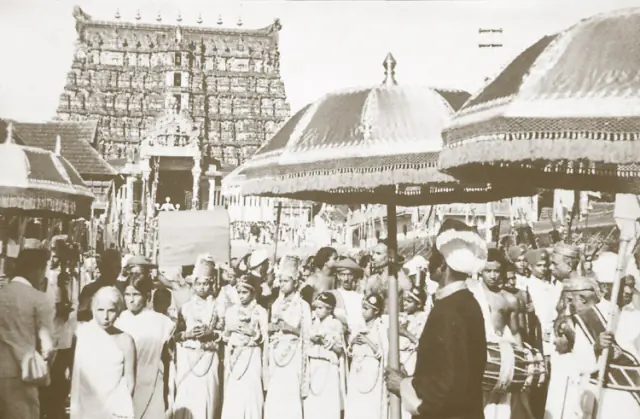
Two lists. Get the left one right and nothing else matters
There is no middle ground and no negotiation at the gate. Staff check clothing before you join the queue, and the decision is final.
What you must wear
- Men wear a mundu or dhoti with the upper body left completely bare
- Women wear a saree, a set-mundu or a long skirt with a blouse
- Girls under twelve may wear a long skirt and blouse, or a plain gown
- Boys under twelve may wear a mundu or shorts, and a shirt is allowed
- A towel or angavastram over the shoulder is permitted for men
What is refused at the gate
- Trousers, jeans and shorts on men, at any point past the entrance
- Shirts, t-shirts and vests anywhere beyond the gate
- Salwar kameez and churidar on women, however modest
- Leggings, jeggings, gowns and any western wear on adult women
- Caps, sunglasses, footwear, bags, phones and cameras
Shops just outside the East Fort entrance sell and rent dhotis for roughly 50 to 100 rupees, so this is fixable on the spot. Allow ten minutes for it if your darshan slot is closing.
The rule changes only for children under twelve
Age is the single factor that relaxes anything. Nationality, ticket type and time of day make no difference at all, and neither does paying for special entry.
| Who you are and what to wear | Enforcement |
|---|---|
| Men, all ages above twelveMundu or dhoti tied at the waist, upper body bare. An angavastram over the shoulder is permitted | Strict |
| Women, all ages above twelveSaree, set-mundu or a long skirt with a blouse. The midriff may be covered | Strict |
| Boys under twelveMundu or shorts. A shirt is allowed at this age | Relaxed |
| Girls under twelveLong skirt and blouse, or a plain full length gown | Relaxed |
| Visitors of Indian origin from abroadSame rules apply. Nationality makes no difference to the dress check | Strict |
| Priests and temple staffTraditional dress at all times, with additional rules inside the sanctum | Strict |
The dress code is older than the building itself
The requirement comes from Kerala temple tradition rather than from any modern rule. The mundu and bare chest are how a devotee has presented themselves before a deity in this region for centuries, and Padmanabhaswamy simply never relaxed it.
Because the temple has been continuously administered by the same family since 1750, there has never been a break in practice where the rule could have quietly loosened. It is the same code the Travancore kings followed when they entered as Padmanabhadasa.
Six things that do not go past the entrance
Free counters near the gate hold everything and give you a token. Budget five minutes for the queue at the cloakroom on top of your darshan slot, and more during the 5:00 PM evening session when it is busiest.
Four steps between the road and the queue
None of this takes long once you know the order. Most of the delay people run into comes from doing it out of sequence.
Everything nobody tells you until you are at the gate
The rule itself is one line. What trips people up is the practical detail around it, and almost none of it is written anywhere at the gate.
Buying a mundu
- Plain cotton is what you want. Skip the bordered or silk versions unless you plan to keep it.
- One size fits everyone. It is a single sheet, tied at the waist, and the shopkeeper will do it for you.
- Ask for a spare knot or a thin cord if you are worried about it coming loose in a moving queue.
For women visiting
- A set-mundu is the local two piece equivalent of a saree and is the easiest option if you do not drape a saree yourself.
- A long skirt with a blouse is accepted, but the skirt has to reach the ankles.
- Bring a safety pin. Queues move slowly and standing for an hour in an unfamiliar drape is easier with one.
Timing the change
Change before you deposit your bag, not after. The cloakroom counters and the shops are in opposite directions, and walking back for a forgotten item costs more time than the change itself.
If you are aiming for Nirmalya Darshanam at 3:30 AM, note that the shops outside open early but not all night. Arriving already dressed is the safer plan for that slot.
Common mistakes
- Assuming a kurta counts. It does not. The upper body has to be bare for men regardless of how traditional the shirt is.
- Wearing the mundu too low. It should sit at the waist and reach the ankles, and staff will point it out if it does not.
- Carrying a phone in a pocket after depositing the bag. Anything found at the check goes back to the cloakroom.
On festival days
- During Alpashy and Painkuni the crowds multiply and the check at the gate moves faster, not slower. Being ready matters more.
- The shops outside run out of stock on the busiest mornings, so buy the day before if your visit falls in a festival week.
- Cloakroom queues are the real bottleneck on those days. Carry as little as possible and you walk straight through.
What the check is actually like
It is quick and impersonal. Staff look at what you are wearing as you approach and either wave you on or point you back toward the shops. There is no discussion and no appeal.
Nobody is embarrassed by it. On any given morning several people in the queue are wearing a mundu bought ten minutes earlier, and the shopkeepers tie dozens a day for first timers.
Padmanabhaswamy Temple dress code, answered
Ten questions on what men and women wear, what happens to children, and what the gate staff actually turn people back for.
What is the dress code at Padmanabhaswamy Temple?
Men wear a mundu or dhoti tied at the waist with the upper body completely bare. Women wear a saree, a set-mundu or a long skirt with a blouse. Trousers, shirts, jeans and salwar kameez are refused at the gate, and the rule is enforced on every visitor.
Can men wear a shirt inside the temple?
No. Men above about twelve must leave the upper body bare from the entrance onward. A thin angavastram or towel over the shoulder is permitted, but a shirt, t-shirt or vest is not, at any point past the gate.
Can women wear salwar kameez?
No. Salwar kameez and churidar are refused for adult women however modest they are. The accepted options are a saree, a set-mundu, or a long skirt worn with a blouse. Girls under twelve have more freedom.
Where can I rent or buy a mundu?
Shops line the road leading to the East Fort entrance and sell plain cotton mundus for roughly 50 to 100 rupees. Several also rent them for a smaller deposit, and the shopkeeper will tie it for you if you have not worn one before.
Are jeans allowed at Padmanabhaswamy Temple?
No. Jeans are refused for both men and women. There is no section of the complex beyond the entrance where western clothing is permitted, and no fee or ticket changes that.
Do children have to follow the dress code?
The rules relax for children under about twelve. Boys may wear a mundu or shorts with a shirt, and girls may wear a long skirt and blouse or a plain full length gown. Above that age the adult rules apply.
Can I carry my phone inside?
No. Phones, cameras and bags all go into the free cloakroom near the gate. Photography is not permitted anywhere past the entrance, and a paid camera permit covers only the outer area of the complex.
Is the dress code different for foreigners?
The dress code is identical for everyone. Nationality makes no difference to the check at the gate. Entry itself, however, is restricted to Hindu devotees, and visitors may be asked to confirm their faith.
What happens if I arrive in the wrong clothes?
You are turned back at the gate before joining the queue. The fix is simple, since the shops outside sell mundus and the change takes a few minutes, but it costs you time you may not have if your darshan slot is closing.
Is there a dress code for the temple museum?
The museum and the outer area are less strict than the sanctum, but modest dress is still expected. The full mundu and bare chest requirement applies from the point where you enter the temple proper, not to the surrounding grounds.
Dress sorted. Now pick your slot
The other thing that decides your visit is which hour you turn up. The 8:30 AM window is the longest and least crowded of the day.
Temple Timings
Every darshan slot from 3:30 AM to the last window at 7:20 PM.
Read the guideTickets & Booking
General darshan is free. What special entry costs at the counter.
Read the guideVault B & Treasure
Six vaults, five counted, and the one door never opened.
Read the guideHow to Reach
Thiruvananthapuram Central is 1.2 km away. Airport, buses and autos.
Read the guideFifty rupees at the shop, or a wasted trip
Buy the mundu outside, tie it at the shop, leave your phone at the cloakroom, and the gate is a formality.