The 108 Divya Desams, region by region
A Divya Desam is not simply a Vishnu temple. It is one of exactly 108 shrines praised in the hymns of the twelve Alvars, and the list has been fixed for more than a thousand years. Padmanabhaswamy is on it. So is Tirupati, so is Badrinath, so is one temple in Nepal, and so are two places that are not on earth at all. Here is the full breakdown, with every Kerala and northern shrine named.
The short answer
The 108 Divya Desams are the Vishnu temples praised by the twelve Alvars in the Nalayira Divya Prabandham, a body of roughly 4,000 Tamil verses. 106 are on earth and two are not: Thirupparkadal, the ocean of milk, and Paramapadam, or Srivaikuntam. Of the earthly ones, 84 are in Tamil Nadu, 11 in Kerala, 4 in Uttar Pradesh, 3 in Uttarakhand, 2 in Andhra Pradesh, 1 in Gujarat and 1 in Nepal. Sree Padmanabhaswamy Temple in Thiruvananthapuram is one of them, and Srirangam is generally regarded as the foremost.
What actually makes a temple a Divya Desam
There are thousands of Vishnu temples in India. Only 108 are Divya Desams, and the qualification is precise: the deity of that temple must have received Mangalasasanam — praise in verse — from one or more of the twelve Alvars.
This is not a ranking by size, wealth or footfall. It is a closed historical list. A temple built in the twelfth century cannot become a Divya Desam, however grand, because the Alvars were no longer there to sing it. Equally, a small and little-visited shrine remains one for ever if it was sung.
That is why the list contains such wildly different places: an enormous working temple complex in Srirangam, a mountain shrine in the Himalayas open a few months a year, a temple in Nepal, and a shrine in Thiruvananthapuram whose sealed vault has been the subject of Supreme Court proceedings.
The twelve Alvars and the four thousand verses
The Alvars were Tamil poet-saints of the Sri Vaishnava tradition, generally placed between roughly the fifth and ninth centuries CE. The word means one immersed, and their poetry is devotional rather than doctrinal: verses addressed directly to the deity of a particular temple, in a particular posture, in a particular place.
Their compositions were later gathered into the Nalayira Divya Prabandham, the collection of four thousand verses that remains central to Sri Vaishnava liturgy. The 108 places named across those verses are the Divya Desams.
Two consequences follow, and both matter for a visitor:
- The temples are described as the Alvars saw them, which is why the posture of the deity is so often the defining feature — reclining, standing, seated — rather than the architecture.
- The list is geographically lopsided. The Alvars travelled and sang mostly in the Tamil country, which is why 84 of the 108 sit in modern Tamil Nadu and the rest thin out with distance.
The 108, state by state
| State or region | Divya Desams |
|---|---|
| Tamil Nadu | 84 |
| Kerala | 11 |
| Uttar Pradesh | 4 |
| Uttarakhand | 3 |
| Andhra Pradesh | 2 |
| Gujarat | 1 |
| Nepal | 1 |
| Not on earth | 2 |
That gives 106 on earth, of which 105 are in India and one is in Nepal, plus the two celestial abodes.
One point of confusion worth clearing up: the traditional region called Malainadu contains 13 Divya Desams, but only 11 of them are in the modern state of Kerala. The other two now fall in Kanyakumari district, Tamil Nadu, and are therefore counted in the Tamil Nadu 84. Both figures are correct; they are counting different things.
The 84 in Tamil Nadu, grouped by cluster
Naming all 84 individually is not much use to a traveller. Grouping them by where they actually sit is, because the pilgrimage is done cluster by cluster.
| Cluster and what anchors it | Base town | Count |
|---|---|---|
| KanchipuramThe densest single cluster on the whole list, anchored by Varadaraja Perumal. | Kanchipuram | 15 |
| Thanjavur and KumbakonamThe Cauvery delta group, walkable in short hops between towns. | Kumbakonam | 13 |
| SirkazhiA tight coastal cluster north of the delta. | Sirkazhi | 13 |
| Tirunelveli and NagercoilThe deep south, including the two Malainadu shrines now in Kanyakumari district. | Tirunelveli | 12 |
| Madurai and the southern beltSpread across Madurai, Virudhunagar, Ramanathapuram and Pudukkottai. | Madurai | 8 |
| Chennai to MahabalipuramIncludes the Arakkonam side and the coastal temples south of the city. | Chennai | 7 |
| Mayiladuthurai and MayavaramThe northern edge of the delta group. | Mayiladuthurai | 7 |
| TiruchirappalliIncludes Srirangam, generally regarded as the foremost Divya Desam. | Tiruchirappalli | 6 |
| Cuddalore and ChidambaramA small group between the delta and the northern coast. | Chidambaram | 3 |
Srirangam deserves its own note. The Ranganathaswamy Temple there is often described as the largest functioning Hindu temple in the world, and it draws around a million visitors during Vaikuntha Ekadashi alone. If you visit only one Divya Desam outside Kerala, it is this one.
The thirteen Malainadu Divya Desams, named
This is the group that includes Padmanabhaswamy, and it is the one most often listed incompletely elsewhere. Eleven are in Kerala; the first two below are now in Kanyakumari district, Tamil Nadu.
| Temple | Place |
|---|---|
| Sree Anantha Padmanabhaswamy Temple | Thiruvananthapuram, Kerala |
| Adhi Kesava Perumal Temple | Thiruvattar, Kanyakumari |
| Thiruvazhmarban Temple | Thiruvanparisaram, Kanyakumari |
| Pambanaiyappan Mahavishnu Temple | Thiruvanvandoor, Kerala |
| Maayapiran Mahavishnu Temple | Thiruppuliyoor, Kerala |
| Parthasarathy Temple | Aranmula, Kerala |
| Imayavarappan Mahavishnu Temple | Thiruchenkundroor (Chengannur), Kerala |
| Arputha Narayana Perumal Temple | Thirukadithanam, Kerala |
| Kolapira Perumal Temple | Thiruvalla, Kerala |
| Lakshmana Perumal Temple | Thirumoozhikkulam, Kerala |
| Kaatkarai Appan Perumal Temple | Thrikkakara, Kerala |
| Nava Mukunda Temple | Thirunavaya, Kerala |
| Uyyavantha Perumal Temple | Thiruvithuvakkodu, Kerala |
Five of these — Thiruvanvandoor, Thiruppuliyoor, Aranmula, Chengannur and Thirukadithanam — sit close together in the Chengannur belt of central Kerala and are traditionally visited as a set, the Pancha Pandava temples. That makes them the easiest cluster on the whole 108 to complete in a day.
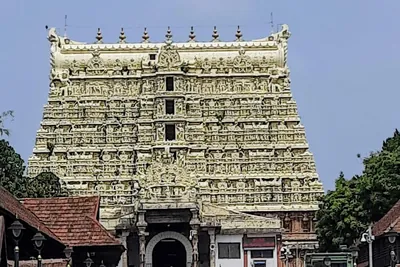
Padmanabhaswamy is the outlier in scale. It is the only Divya Desam where the deity is so large that it must be viewed through three separate doors, and the only one whose treasure has been catalogued under court supervision. Our architecture page covers the sanctum arrangement in detail.
The eleven in the north, and the one in Nepal
These are the shrines the Alvars sang from a distance, and they include some of the most famous temples in India.
| Temple | Place |
|---|---|
| Thiruvengadam, Venkateswara Temple | Tirumala, Andhra Pradesh |
| Ahobilam, Narasimha temples | Ahobilam, Andhra Pradesh |
| Thiru Ayodhi | Ayodhya, Uttar Pradesh |
| Thiru Naimisaranyam | Naimisharanya, Uttar Pradesh |
| Thiruvaaipadi | Gokul, Uttar Pradesh |
| Thiru Vadamathura | Mathura, Uttar Pradesh |
| Thirukkandam, Neelamega Perumal | Devaprayag, Uttarakhand |
| Thiruppiridhi, Paramapurusha Perumal | Joshimath, Uttarakhand |
| Thiruvadhari Ashramam, Badri Narayana | Badrinath, Uttarakhand |
| Thiru Dwaraka | Dwarka, Gujarat |
| Thirusaligramam, Muktinath | Mustang, Nepal |
Two of these carry practical warnings. Muktinath is the only Divya Desam outside India, sits at high altitude in the Nepalese Himalaya, and requires a separate trip in every sense. Badrinath, Joshimath and Devaprayag are Himalayan and seasonal, closed through the winter.
Tirumala is the one most pilgrims have already visited without registering that it is on the list. It is also the point of comparison people most often reach for when they read about Padmanabhaswamy's wealth — a comparison we take apart in the richest temples in India.
The two that are not on earth
Two of the 108 cannot be visited, and they are not omissions or lost sites. They were never terrestrial.
- Thirupparkadal, the ocean of milk, or Kshira Sagara. In Vaishnava cosmology this is where Vishnu reclines on the serpent Anantha between cycles of creation.
- Paramapadam, also called Srivaikuntam. The final abode, the destination of the liberated soul.
For a visitor to Thiruvananthapuram this is more than a footnote. The Ananthashayanam posture in the Padmanabhaswamy sanctum — Vishnu reclining on the thousand-headed Anantha — is a depiction of Thirupparkadal itself. One of the two unreachable Divya Desams is what the reachable one is showing you.
How the pilgrimage is actually done
Completing all 106 earthly Divya Desams is a recognised undertaking, and people do it, but almost nobody does it in one journey.
- By cluster, over years. The standard approach. Kanchipuram in one trip, the Kumbakonam delta in another, Malainadu in a third. Nine Tamil Nadu clusters plus Malainadu plus the north covers everything.
- Malainadu is the easiest starting block, because five of the thirteen are within a short radius in the Chengannur belt and can be done in a single day.
- The north is the constraint. Badrinath, Joshimath and Devaprayag are seasonal, and Muktinath needs a Nepal trip. Plan these first, not last.
- Check timings for every single one. South Indian temples close for several hours in the middle of the day, and the small Divya Desams keep shorter hours than the famous ones. This is the most common way a day gets wasted.
If Padmanabhaswamy is your first, the first-time visitor guide sets out arrival, dress and the five-hour closure in order, and the timings page has every darshan window.
Key points to remember
- A Divya Desam is a Vishnu temple praised in verse by one or more of the twelve Alvars. The list is closed and fixed at 108.
- 106 are on earth: 105 in India and one, Muktinath, in Nepal. Two are celestial.
- Tamil Nadu holds 84, Kerala 11, Uttar Pradesh 4, Uttarakhand 3, Andhra Pradesh 2, Gujarat 1.
- The Malainadu region has 13, of which 11 are in Kerala and two now fall in Kanyakumari district, Tamil Nadu.
- Sree Padmanabhaswamy Temple is a Malainadu Divya Desam, and the only one where the deity is viewed through three doors.
- Srirangam is generally regarded as the foremost, and is often called the largest functioning Hindu temple in the world.
- The two celestial ones are Thirupparkadal, the ocean of milk, and Paramapadam or Srivaikuntam.
- Most pilgrims complete the list cluster by cluster over years. The Himalayan shrines are seasonal, so plan those first.
Sources and further reading
The 108 Divya Desams, answered
Ten questions on the list, the counts, the celestial two and how the pilgrimage works.
What is a Divya Desam?
A Divya Desam is one of 108 Vishnu temples praised in verse by the twelve Alvars, the Tamil poet-saints of the Sri Vaishnava tradition, in the Nalayira Divya Prabandham. The qualification is having received Mangalasasanam from an Alvar, not size or wealth, and the list has been closed for over a thousand years.
How many Divya Desams are in Tamil Nadu?
84 of the 108 are in Tamil Nadu. The densest cluster is Kanchipuram with 15, followed by the Thanjavur and Kumbakonam delta with 13 and Sirkazhi with 13. The Alvars travelled and sang mostly in the Tamil country, which is why the list is so heavily concentrated there.
How many Divya Desams are in Kerala?
Eleven are in the modern state of Kerala. The traditional Malainadu region contains thirteen, but two of those — Thiruvattar and Thiruvanparisaram — now fall in Kanyakumari district, Tamil Nadu, and are counted in that state's 84. Both figures are correct; they count different things.
Is Padmanabhaswamy Temple a Divya Desam?
Yes. Sree Anantha Padmanabhaswamy Temple in Thiruvananthapuram is one of the thirteen Malainadu Divya Desams and the most significant of them. It is also the only one on the whole list where the deity is so large that it is viewed through three separate doors.
Which two Divya Desams are not on earth?
Thirupparkadal, the ocean of milk or Kshira Sagara, where Vishnu reclines on the serpent Anantha; and Paramapadam, also called Srivaikuntam, the final abode. Neither can be visited. The Ananthashayanam posture at Padmanabhaswamy is a depiction of the first of the two.
Which is the first or foremost Divya Desam?
Srirangam, the Ranganathaswamy Temple near Tiruchirappalli, is generally regarded as the foremost. It is often described as the largest functioning Hindu temple in the world and draws around a million visitors during Vaikuntha Ekadashi alone.
Which Divya Desam is outside India?
Muktinath, known in the tradition as Thirusaligramam, in the Mustang district of Nepal. It is the only Divya Desam outside India, sits at high altitude in the Himalaya, and requires a separate trip with its own permits and season.
Who were the twelve Alvars?
Tamil poet-saints of the Sri Vaishnava tradition, generally placed between roughly the fifth and ninth centuries CE. Their devotional verses were later gathered into the Nalayira Divya Prabandham, a collection of about four thousand verses that remains central to Sri Vaishnava liturgy.
How long does it take to visit all 108 Divya Desams?
Only 106 can be visited, and almost nobody does it in one journey. The standard approach is cluster by cluster over several years: the nine Tamil Nadu clusters, the Malainadu group in Kerala, and the northern shrines. The Himalayan ones are seasonal and Muktinath needs a Nepal trip, so plan those first.
Which Divya Desams are easiest to visit together?
The five Pancha Pandava temples in the Chengannur belt of central Kerala — Thiruvanvandoor, Thiruppuliyoor, Aranmula, Chengannur and Thirukadithanam — sit close enough together to complete in a single day. Kanchipuram's fifteen are the densest cluster overall and take two to three days.