The Kerala temple dress code, and how to actually wear a mundu
Every guide tells you Kerala temples have a dress code. Almost none of them tell you what a mundu actually is, how to put one on, or why the man at the gate of Padmanabhaswamy will refuse you when the temple you visited yesterday did not. This covers the garments themselves, the rule as it is actually applied, how strict different Kerala temples are, and what to do when you have arrived in the wrong clothes.
The short answer
Traditional Kerala temple dress means a mundu for men, a single unstitched cloth wrapped at the waist, and at the strictest temples the upper body must be completely bare. Women wear a saree or a set-mundu, the two-piece Kerala equivalent. Padmanabhaswamy enforces the strictest version of this and refuses trousers, jeans, shirts, leggings, salwar kameez and churidar at the gate. Mundus rent outside for roughly ₹50 to ₹100; a saree cannot be improvised, so women should arrange it in advance.
What a mundu actually is
A mundu is a single rectangle of unstitched cloth, usually cotton, worn wrapped around the waist and reaching the ankles. It is the traditional lower garment of Kerala for men and it is still ordinary daily wear for a great many people, not a costume put on for temples.
The plain white or cream mundu is the standard. A kasavu mundu carries a gold-coloured zari border and is the version worn for festivals, weddings and temple visits. Either is acceptable at a temple; kasavu simply looks more formal.
You will hear the word veshti used for what is essentially the same garment; it is the Tamil term, and Tamil Nadu temples that require traditional dress ask for a veshti in the same way. Dhoti is the broader north Indian word for the category. In practice, at a Kerala temple gate, all three words will get you the right piece of cloth.
An angavastram or melmundu is the second, smaller cloth draped over the shoulder. At Padmanabhaswamy this is permitted, which matters: it is not a shirt, but it is not nothing either.
How to actually wear one
Nobody explains this and it is the reason first-time wearers spend the queue worrying about the wrong thing. The basic wrap:
- Hold the cloth behind you at waist height, one edge in each hand, with the top edge level with your navel.
- Bring both ends round to the front so the cloth wraps your waist once.
- Overlap the ends and pull them snug, then roll the top edge down on itself two or three times, tightly, at the waist. The roll is what holds it, not a knot.
- Check the hem sits at the ankle and that you can walk a normal stride.
Two things worth knowing. Men often fold the mundu up to knee length for comfort in ordinary daily life; do not do this inside a temple, where it stays full length. And a mundu worn correctly holds perfectly well, but a mundu rolled loosely will work its way loose as you walk, so tighten it more than feels necessary.
Practise once at your hotel before the morning. Two minutes in a room is worth a great deal more than the first attempt in a queue.
Why the upper body must be bare
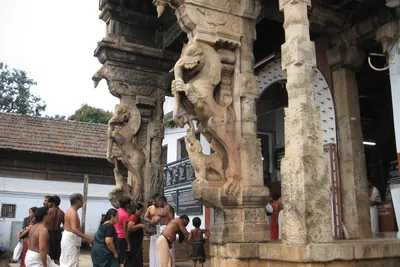
This is the rule that surprises visitors most, and it is the one that trips up men who have correctly obtained a mundu and then kept their shirt on. At Padmanabhaswamy, and at a number of other traditional Kerala temples, men enter with the upper body completely bare.
The practice comes from an older convention of approaching the deity without the coverings associated with status and the outside world. Removing the upper cloth is an act of humility and of ritual readiness, in the same family of ideas as removing footwear.
Practically, what this means at the gate:
- No shirt, t-shirt, vest or banian. There is no version of an upper garment that is acceptable.
- An angavastram over the shoulder is permitted and is what most local devotees wear.
- It applies to adult men. Boys under twelve may wear a shirt.
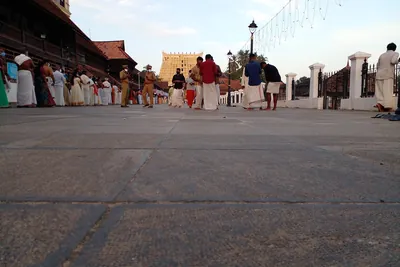
Visitors sometimes find this uncomfortable. It is worth knowing in advance that in the queue you will be surrounded by people dressed identically, and it stops registering within about a minute.
What women are expected to wear
The women's rule is more forgiving on the body but stricter on the garment, and it catches out more visitors than the men's rule because there is no equivalent of a rented mundu.
Accepted at Padmanabhaswamy:
- A saree.
- A set-mundu, also called mundum neriyathum, the two-piece Kerala garment of a lower cloth and an upper cloth, usually cream with a kasavu border. This is the distinctively Kerala option and the one most local women wear to temple.
- A long skirt with a blouse.
- Girls under twelve: a long skirt and blouse, or a plain gown.
Refused: salwar kameez and churidar, which surprises many Indian visitors because they are accepted at most temples elsewhere in India. Also leggings, jeans, trousers and western dress of any kind.
The practical consequence: arrange this before you travel. A saree is not something to buy and drape for the first time on the morning of a darshan, and the rental stalls outside serve men far better than women.
Exactly what is refused
The check happens before you join any queue, staff make the call, and the decision is final. The refusal list at Padmanabhaswamy is:
- Trousers and jeans, on anybody.
- Shorts on adult men.
- Any upper garment on adult men, including shirts, t-shirts and vests.
- Leggings, salwar kameez and churidar on women.
- Western dress of any description.
Separately, and easy to forget once you have changed: leather items are not taken inside, which includes a belt. And footwear, bags, phones and cameras all go to the cloakroom regardless of what you are wearing. The full checkpoint sequence is on our temple rules page, and the dress rules in complete form are on the dress code page.
How strict different temples actually are
Visitors generalise from one temple to another and get caught. The range across Kerala and the south is wide.
- Padmanabhaswamy: the strictest version. Mundu and bare chest for men, saree or set-mundu for women, enforced on every visitor at the gate.
- Guruvayur and other traditional Kerala temples: similar traditional-dress expectations, with details varying by temple.
- Many Tamil Nadu temples: a veshti is expected at some major shrines, but the bare-chest requirement is less consistently applied.
- Most north Indian temples: modest dress is expected, but traditional garments are generally not required.
The rule of thumb that actually works: check the specific temple, and assume Kerala is stricter than wherever you were last. Note also that Padmanabhaswamy applies a separate restriction, entry is limited to Hindus, which is a different rule from the dress code and has to be satisfied as well.
Renting, buying and what it costs
Renting. Stalls outside the temple rent mundus for roughly ₹50 to ₹100. This solves the problem for men entirely and is what most visiting men do. Two cautions: the stalls keep their own hours and cannot be relied on for a 3:00 AM Nirmalya Darshanam arrival, and at busy times there is a queue for them too.
Buying. A plain cotton mundu is inexpensive at any cloth shop in Thiruvananthapuram, and Chalai Bazaar a kilometre from the temple is the obvious place. A kasavu mundu with the gold border costs more and makes a genuinely good thing to take home.
For women, a set-mundu bought in Kerala is both the correct garment for the temple and the most characteristic thing you can buy in the state. If you are visiting more than one Kerala temple, it pays for itself in convenience.
Buy the day before rather than on the morning. It costs about the same, and it removes the one variable you cannot control at the gate.
If you turn up in the wrong clothes
It happens constantly. What to do, in order of how well it works.
- Men: rent a mundu outside. Change away from the gate, take off your shirt, and rejoin. Total cost about ₹50 to ₹100 and about ten minutes. This is a complete fix.
- Women: buy a saree or set-mundu nearby. Shops around East Fort and Chalai stock them. Slower than the men's fix but workable if you have time before the slot closes.
- Come back for a later slot. If you are refused at 11:45 AM the next opening is 5:00 PM, so use the closure to sort clothing and return in the evening.
- Do not argue. Staff apply a rule they cannot waive and the decision is final.
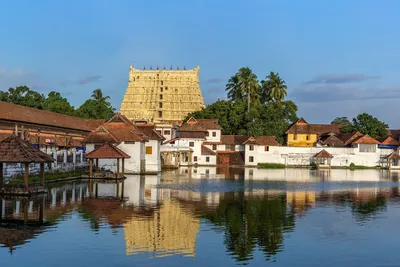
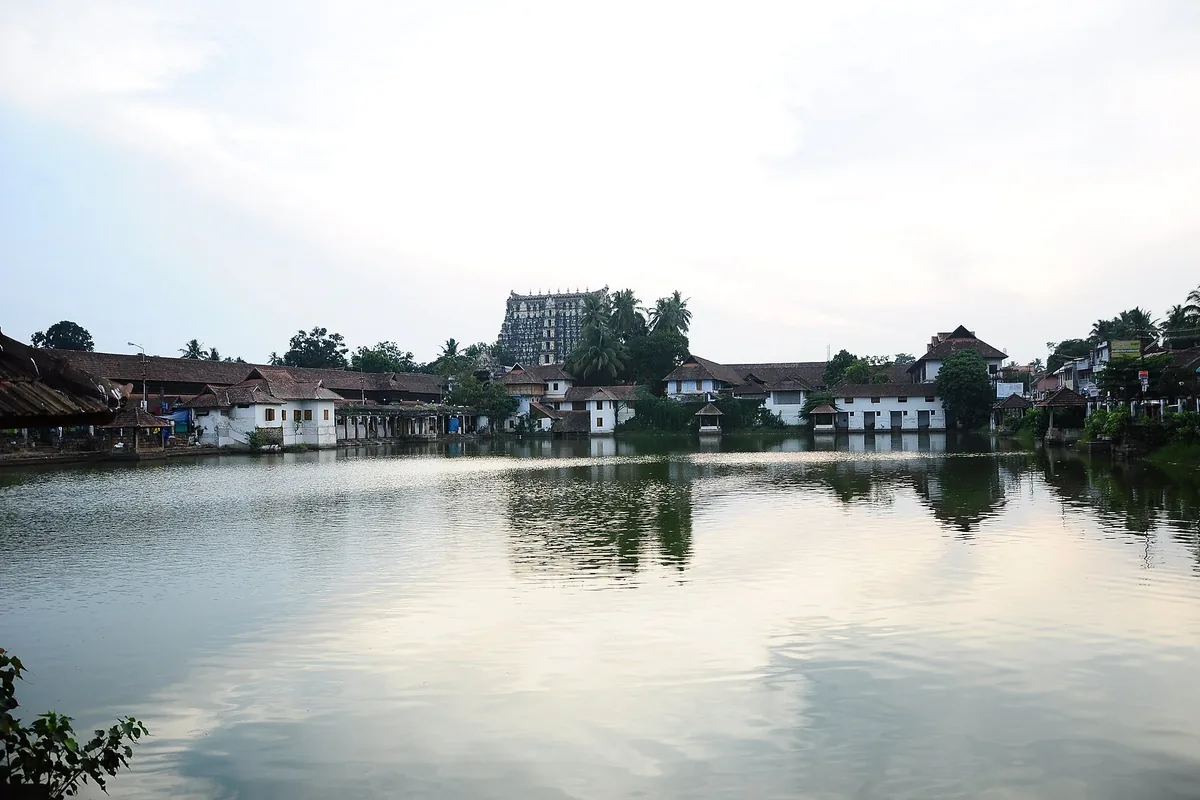
If nothing can be fixed in time, the day is not lost. The gopuram and the tank are outside the checkpoint, and Kuthiramalika Palace next door is open to everyone. Our places to visit guide covers the alternatives, and the first-time visitor guide plans the whole day properly.
Key points to remember
- A mundu is a single unstitched cloth wrapped at the waist. Veshti and dhoti refer to essentially the same garment.
- At Padmanabhaswamy adult men wear it with the upper body completely bare. An angavastram over the shoulder is allowed.
- The wrap is held by rolling the top edge down on itself two or three times, not by a knot. Practise once first.
- Women wear a saree, a set-mundu or a long skirt with blouse. Salwar kameez and churidar are refused here.
- Refused: trousers, jeans, shorts on men, any upper garment on men, leggings and western dress.
- Mundus rent outside for ₹50 to ₹100. There is no equivalent quick fix for women, so arrange it in advance.
- Padmanabhaswamy is the strictest in Kerala. Do not generalise from any other temple you have visited.
Sources and further reading
The dress code, answered
Ten questions on mundus, sarees, what is refused and what to do if you arrive wrong.
What is the dress code for Kerala temples?
Traditional dress. Men wear a mundu, a single unstitched cloth wrapped at the waist, and at the stricter temples the upper body must be completely bare. Women wear a saree or a set-mundu. Details vary by temple, and Padmanabhaswamy enforces the strictest version in the state.
What is a mundu and how do I wear one?
A mundu is a rectangle of unstitched cotton worn wrapped around the waist to the ankles. Hold it behind you at waist height, bring both ends round to the front, overlap them, and roll the top edge down on itself two or three times tightly. The roll holds it, not a knot. Practise once before you go.
Do men have to remove their shirt at Padmanabhaswamy Temple?
Yes. Adult men enter with the upper body completely bare. No shirt, t-shirt or vest is acceptable at any point. An angavastram or towel over the shoulder is permitted and is what most local devotees wear. Boys under twelve may wear a shirt.
What should women wear to Padmanabhaswamy Temple?
A saree, a set-mundu, or a long skirt with a blouse. Girls under twelve may wear a long skirt and blouse or a plain gown. Salwar kameez, churidar, leggings, trousers and western dress are all refused, which surprises many Indian visitors because those are accepted at most temples elsewhere.
Is salwar kameez allowed at Padmanabhaswamy Temple?
No. Salwar kameez and churidar are refused at the gate, along with leggings, jeans and trousers. This is stricter than most Indian temples and it catches out a large number of visitors who assume it will be acceptable.
Can I rent a mundu at the temple?
Yes. Stalls outside the temple rent mundus for roughly ₹50 to ₹100 and this is what most visiting men do. The stalls keep their own hours, so do not rely on them for an early morning arrival, and expect a queue at busy times. There is no comparable rental option for women.
What is the difference between a mundu, a veshti and a dhoti?
They are essentially the same garment under different names. Mundu is the Kerala term, veshti the Tamil one, and dhoti the broader north Indian word for the category. At a Kerala temple gate any of the three words will get you the right piece of cloth.
What is a set-mundu?
Also called mundum neriyathum, it is the two-piece Kerala women's garment of a lower cloth and an upper cloth, usually cream with a gold-coloured kasavu border. It is the distinctively Kerala option and the one most local women wear to temple.
What happens if I arrive in the wrong clothes?
You will be refused before you join the queue and the decision is final. Men can rent a mundu outside for about ₹50 to ₹100 and rejoin within ten minutes. Women can buy a saree or set-mundu at shops around East Fort or Chalai. If you are refused late in the morning, use the midday closure and return for the 5:00 PM slot.
Are other Kerala temples as strict as Padmanabhaswamy?
Not usually. Traditional Kerala temples such as Guruvayur have similar expectations with details varying, many Tamil Nadu temples apply the veshti requirement less consistently, and most north Indian temples ask only for modest dress. Assume Kerala is stricter than wherever you were last, and check the specific temple.