Sabarimala opening dates 2026-27, and what each window is for
Sabarimala is shut for most of the year. It opens for five days at the start of each Malayalam month, for the long Mandala-Makaravilakku season in winter, and for Vishu in April. Turning up outside those windows means a closed sanctum after a five-hour drive and a climb. This is the full 2026-27 calendar, what the 41-day vratham involves, how the virtual queue works, and where the temple sits in relation to Thiruvananthapuram.
The short answer
For the 2026-27 season, Sabarimala opens on 16 November 2026 for the Mandala pilgrimage, with Mandala Pooja on 26 December 2026. It closes, reopens on 30 December 2026 for the Makaravilakku leg, and the peak day, Makara Jyothi, falls on 14 January 2027, after which the season ends on 20 January 2027. Outside that season the temple opens only for the first five days of each Malayalam month and for Vishu in April. Darshan during the main season needs a Virtual Queue slot booked at sabarimalaonline.org. All dates are set annually by the Travancore Devaswom Board and can shift by a day, so confirm before you travel.
Sabarimala opening dates for 2026-27
The season everyone means when they say "Sabarimala season" is Mandala-Makaravilakku, which runs from mid-November to late January in two legs with a short closure between them.
| Occasion and what happens | Dates | Leg |
|---|---|---|
| Mandala season opensThe temple opens on the first of Vrischikam. Doors typically open at 5:00 PM on the opening day itself. | 16 November 2026 | Mandalam |
| Mandala PoojaThe concluding ritual of the 41-day Mandala period, and the busiest single day of the first leg. | 26 December 2026 | Mandalam |
| Temple closes brieflyA short closure separates the Mandala leg from the Makaravilakku leg. | 27 to 29 December 2026 | Closed |
| Makaravilakku leg opensThe temple reopens for the run-up to Makara Sankranti. | 30 December 2026 | Makaravilakku |
| Makara Jyothi and MakaravilakkuThe peak day of the entire season, and by a wide margin the heaviest crowd of the year. | 14 January 2027 | Makaravilakku |
| Season closesThe temple shuts until the next monthly window. | 20 January 2027 | Makaravilakku |
| Vishu seasonA short spring opening; Vishukkani darshan falls on 14 April 2027. | 10 to 19 April 2027 | Vishu |
Confirm before booking. These dates come from the published 2026-27 pilgrimage calendar, and independent listings differ by a day on the Mandala Pooja closure. The Travancore Devaswom Board issues the authoritative schedule each year, and a one-day shift is normal.
The monthly five-day windows
Outside the winter season, Sabarimala opens for roughly the first five days of each Malayalam month for monthly poojas. These windows are far quieter than the season and are the sensible choice if crowds are your main concern.
| Malayalam month | Dates |
|---|---|
| Mithunam | 17 to 21 June 2026 |
| Karkidakam | 17 to 21 July 2026 |
| Chingam (Onam) | 17 to 21 August 2026 |
| Kanni | 17 to 21 September 2026 |
| Thulam | 18 to 22 October 2026 |
| Kumbham | 12 to 16 February 2027 |
| Meenam | 14 to 18 March 2027 |
Note the gap: there is no separate monthly window in November, December or January, because the Mandala-Makaravilakku season covers those months entirely.
The temple typically opens at 5:00 PM on the first day of a window and closes after the evening rituals on the last. Do not plan to arrive on a closing day and expect a full day of darshan.
The 41-day vratham
Sabarimala is the rare major pilgrimage where the preparation is longer than the journey. Traditionally a pilgrim observes a 41-day vratham before setting out, beginning around the start of Vrischikam.
What it involves, in the common form:
- Black or dark blue clothing for the whole period, and a tulsi or rudraksha mala worn from the day the vratham is taken.
- Vegetarian food, no alcohol, no tobacco.
- Celibacy and abstention from ordinary social entertainments.
- Daily bathing and temple visits, usually twice a day.
- Addressing other pilgrims as Swami, which is why the whole cohort is referred to collectively that way.
The vratham is a devotional discipline rather than an administrative requirement. Nobody checks it at a gate. What is checked, at the eighteen steps, is the irumudikettu.
One of the pilgrimage's more remarkable features is that it is open to men of any religion who observe the vratham, and the Erumely leg of the traditional route includes a mosque associated with Vavar, a companion of Ayyappan in the temple's own tradition. That openness is the exact opposite of the arrangement at Padmanabhaswamy, where entry is restricted to Hindus.
Irumudikettu, and the eighteen steps
The irumudikettu is a two-compartment cloth bundle carried on the head. The front compartment holds the offerings for the deity, including the ghee-filled coconut used for neyyabhishekam; the rear holds the pilgrim's own provisions for the journey. It is tied in a formal ceremony at a local temple before departure.
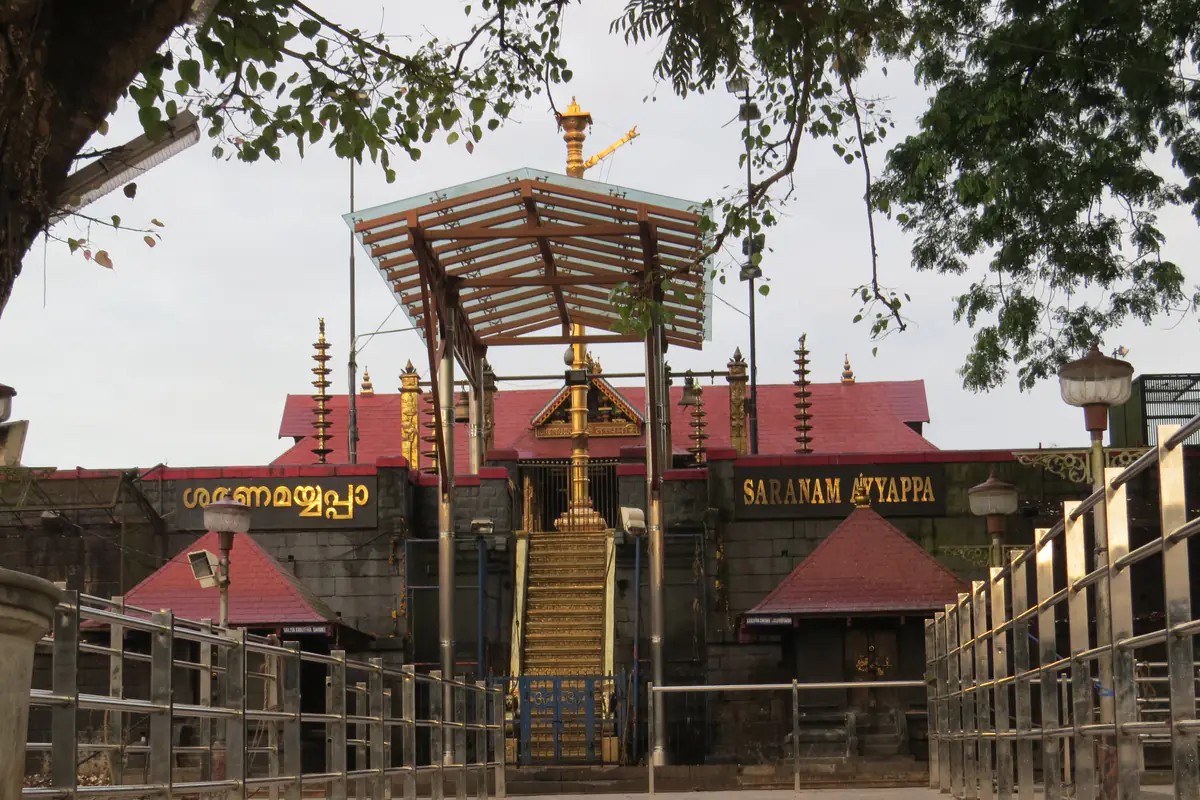
It matters because of the pathinettam padi, the eighteen holy steps that lead to the sanctum:
- Only a pilgrim carrying an irumudikettu may climb the eighteen steps. This is enforced, not advisory.
- Pilgrims without one reach the sannidhanam by a separate route and take darshan without ascending the steps.
- Each of the eighteen steps carries its own traditional significance, and the ascent is the ritual climax of the whole pilgrimage.
If you are travelling as an observer rather than as a vratham-keeping pilgrim, plan on the second arrangement. It is entirely normal and nobody will obstruct you.
Routes, and the climb from Pamba
The temple sits at about 1,260 m in the Western Ghats, in Pathanamthitta district, inside the Periyar Tiger Reserve. There is no road to the shrine itself. Every pilgrim walks the last stretch.
- Pamba is the road head and the base for the overwhelming majority of pilgrims. Vehicles stop here, and the climb to the sannidhanam via Neelimala is roughly 5 km. Most people take three to four hours with rests.
- Nilackal is the outer parking and transit hub. In the season, private vehicles are held here and pilgrims are shuttled down to Pamba.
- The traditional Erumely route is the long one: a forest trek of roughly 45 km on foot via Azhutha, Karimala and Valiyanavattom before joining Pamba. It takes two to three days and is undertaken by a minority who want the full traditional pilgrimage.
- Distance from Thiruvananthapuram to Sabarimala is about 191 km, which is a four to five hour drive to Pamba on a good day and considerably longer in season.
The climb is genuinely strenuous. Elderly pilgrims and those who cannot manage it use dolis, the carried chairs stationed at Pamba, for a negotiated fee.
The virtual queue, and what it actually books
During the main season, darshan is managed through a Virtual Queue system operated at sabarimalaonline.org. Booking opens well ahead of the season, and daily capacity is split between online slots and a smaller spot-booking allocation at the base.
Three things to understand about it:
- It books a date and a time band, not a ticket to the sanctum. Darshan itself is free. The queue exists to spread arrivals across the day.
- Peak dates go early. Makara Jyothi and the days either side of it are the first to fill, followed by weekends through Mandalam.
- Spot booking exists but is not a plan. Treat it as a fallback, not a strategy, in the peak weeks.
This is worth flagging because the situation is the mirror image of Padmanabhaswamy, where no online booking portal exists at all and every ticket is bought in cash at an on-site counter. If you are visiting both, do not assume one temple's system tells you anything about the other's.
The women's entry question, stated plainly
This is the most searched and most misreported thing about Sabarimala, so here is the sequence of facts.
- The temple historically did not admit women of menstruating age, conventionally stated as 10 to 50.
- On 28 September 2018, a five-judge bench of the Supreme Court held by 4:1 that the exclusion was unconstitutional, and struck down the rule that permitted it.
- More than fifty review petitions were filed. On 14 November 2019, the bench by 3:2 kept the review petitions pending and referred the wider religious questions to a larger bench.
- That reference has not been finally resolved, so the matter remains before the courts.
In practice, the traditional restriction has continued to be observed at the shrine in the years since. If this affects your travel, check the current position close to your dates through the Travancore Devaswom Board and current news reporting rather than relying on any article, including this one.
Fitting Sabarimala around a Thiruvananthapuram trip
A great many pilgrims combine the two, and the combination works well because the temples make completely different demands.
- Sabarimala is a season, Padmanabhaswamy is a schedule. One is available only on fixed dates; the other is open almost every day but shuts for five hours in the middle of it. Our timings page has the daily windows.
- Both enforce traditional dress, differently. Sabarimala pilgrims wear black or blue and carry the irumudi; Padmanabhaswamy requires a mundu with a bare torso for men and a saree or set-mundu for women, and refuses people at the gate daily. See the dress code page.
- Do Padmanabhaswamy first if you are heading north. Thiruvananthapuram is the arrival city for most international and many domestic pilgrims, and the drive to Pamba runs away from it.
- The winter season overlaps with the best weather for the coast. See hotels nearby and how to reach for the Thiruvananthapuram end.
If Sabarimala is your anchor and you want to see what else in Kerala is worth the detour, our guide to famous temples in Kerala covers the ones that are actually on the way.
Key points to remember
- Mandala season opens 16 November 2026, with Mandala Pooja on 26 December 2026.
- The Makaravilakku leg opens 30 December 2026, peaks at Makara Jyothi on 14 January 2027, and closes 20 January 2027.
- Outside the season the temple opens only for about the first five days of each Malayalam month, plus Vishu from 10 to 19 April 2027.
- The temple usually opens at 5:00 PM on the first day of any window.
- Darshan in season needs a Virtual Queue slot from sabarimalaonline.org; darshan itself is free.
- Only pilgrims carrying an irumudikettu may climb the eighteen holy steps; others take darshan by a separate route.
- Pamba is the road head, and the climb to the sannidhanam is roughly 5 km. Sabarimala is about 191 km from Thiruvananthapuram.
- The 2018 Supreme Court judgment on women's entry was followed by a 2019 reference to a larger bench that remains unresolved; check the current position before travelling.
Sabarimala dates, answered
Ten questions on the calendar, the vratham, the climb and who can go.
When does Sabarimala open in 2026?
The Mandala pilgrimage season opens on 16 November 2026, on the first day of the Malayalam month of Vrischikam. The temple typically opens at 5:00 PM on that day. Before then, the temple opens only for the five-day monthly windows.
When is Makaravilakku and Makara Jyothi in 2027?
Makara Jyothi and Makaravilakku fall on 14 January 2027. It is the single busiest day of the Sabarimala year. The Makaravilakku leg of the season opens on 30 December 2026 and closes on 20 January 2027.
Is Sabarimala open all year?
No. It is closed for most of the year. It opens for roughly the first five days of each Malayalam month, for the long Mandala-Makaravilakku season from mid-November to late January, and for Vishu in April. Arriving outside those windows means a closed sanctum.
Do I need to book darshan at Sabarimala?
During the main season, yes. Darshan is managed through the Virtual Queue at sabarimalaonline.org, which allocates a date and time band. A smaller spot-booking allocation exists at the base but should be treated as a fallback rather than a plan. Darshan itself is free.
What is the 41-day vratham?
A 41-day discipline observed before the pilgrimage: black or dark blue clothing, a tulsi or rudraksha mala, vegetarian food, no alcohol or tobacco, celibacy, and daily bathing and temple visits. It is a devotional practice, not an administrative requirement, and nobody verifies it at a gate.
Can I climb the eighteen steps without an irumudikettu?
No. Only a pilgrim carrying an irumudikettu, the two-compartment head bundle tied in a ceremony before departure, may climb the pathinettam padi. Everyone else reaches the sannidhanam by a separate route and takes darshan without ascending the steps.
How far is the climb from Pamba to the temple?
Roughly 5 km from Pamba to the sannidhanam via Neelimala, taking most people three to four hours with rests. There is no road to the shrine. Carried chairs, called dolis, are available at Pamba for a negotiated fee for those who cannot manage the climb.
Can women visit Sabarimala?
Girls under about 10 and women over about 50 have always been admitted. For women of menstruating age, a five-judge Supreme Court bench held the exclusion unconstitutional in September 2018, but in November 2019 the review petitions were kept pending and the wider questions referred to a larger bench, which has not finally resolved them. In practice the traditional restriction has continued to be observed. Check the current position close to your travel dates.
Can non-Hindus go to Sabarimala?
Sabarimala is open to pilgrims of any religion who observe the vratham, and the traditional Erumely route includes a mosque associated with Vavar, a companion of Ayyappan in the temple's tradition. This is the opposite of the arrangement at Padmanabhaswamy in Thiruvananthapuram, which restricts entry to Hindus.
How far is Sabarimala from Thiruvananthapuram?
About 191 km, in Pathanamthitta district. That is a four to five hour drive to the Pamba road head in normal conditions and considerably longer during the season, before the roughly 5 km climb on foot. Many pilgrims arrive through Thiruvananthapuram airport and take in Padmanabhaswamy Temple on the way.