Lakshadeepam, the lakh of lamps that comes once in six years
Most of what happens at this temple happens daily, or twice a year. One thing happens once in six. Lakshadeepam ends a fifty-six day cycle of continuous Vedic recitation by lighting a hundred thousand oil lamps in and around the complex, and it is the single most spectacular night in the temple's calendar. This covers what the ritual actually consists of, how the six-year cycle is counted, when the next one is due and what a visitor needs to know to be there.
The short answer
Lakshadeepam means a lakh of lamps, one hundred thousand. It is held once every six years at Padmanabhaswamy Temple and it is the concluding night of Murajapam, a fifty-six day cycle of continuous Vedic chanting. On the final night the temple, its corridors, walls and surroundings are lit entirely by oil lamps. Documented recent cycles fell in 2014 and 2020, placing the following one in early 2026 and the next around 2032. Confirm dates with the temple's own announcement before booking.
Murajapam, the fifty-six days that come first
Lakshadeepam is the ending of something much longer. It closes Murajapam, a cycle of continuous Vedic chanting that runs for fifty-six days inside the temple, performed by assembled Brahmin scholars in relays so that the recitation does not break.
The word comes from mura, meaning a turn or a round. The recitation is organised in rounds, and the whole fifty-six day span is counted as a single unbroken ritual act performed on behalf of the kingdom and its people. It is one of the largest sustained recitation rituals anywhere in India.
The arrangement dates to the same period as the temple's transformation under Marthanda Varma, and it belongs to the logic of the Thrippadidanam of 1750: a state that had made a deity its sovereign undertook ritual obligations to him on a scale no ordinary shrine would attempt.
Devotees can be present through the Murajapam period, and the temple is markedly more active than usual for those eight weeks. But the recitation itself is a ritual performance rather than a public spectacle, and most of it takes place away from the darshan queue.
How the six-year cycle actually works
The Murajapam cycle repeats every six years, and Lakshadeepam is the concluding night of each cycle. Within that six-year span there are shorter recitation observances, but the full fifty-six day Murajapam with Lakshadeepam at the end is the six-yearly event.
The timing falls in the winter months, and recent occurrences have concluded in January. The precise dates are fixed by the Malayalam calendar, so they move relative to the Gregorian one and are announced by the temple ahead of the cycle.
Because the interval is six years rather than one, this is the one event at Padmanabhaswamy that genuinely rewards planning years ahead. Miss it and the next chance is most of a decade away, which is not true of anything else in the calendar. Both of the ten-day Utsavams, Painkuni in spring and Alpashy in autumn, come round every year.
Our festivals page places Lakshadeepam alongside the rest of the calendar so you can see how rare it actually is.
What a hundred thousand lamps actually looks like
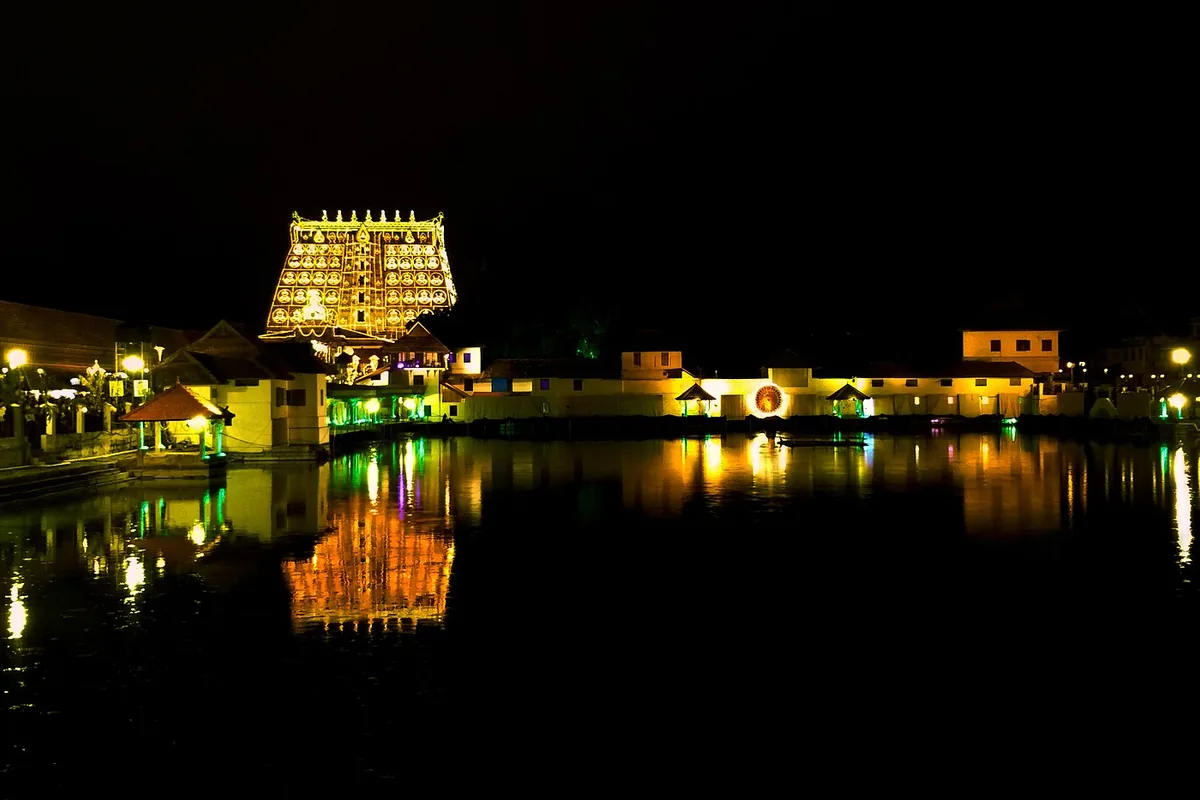
On the closing night the electric lighting gives way to oil lamps. Traditional lamps are placed along the walls of the complex, through the pillared corridor, around the tank and on the surrounding structures, and they are lit as a body rather than progressively.
The figure of a lakh is the name of the festival and is best treated as the traditional count rather than an audited one. What is not in question is that the scale is enormous and that the effect is completely different from anything the temple looks like on an ordinary evening.
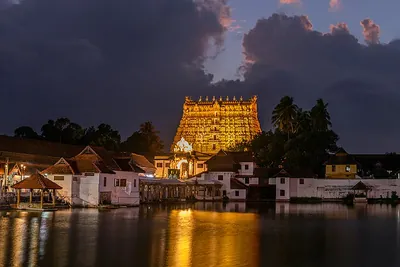
Two things make it visually distinctive. The granite that Marthanda Varma chose for the rebuild reads very differently under flame than under electric light, with the carving on the corridor columns picking up shadow that daylight flattens. And the seven-storey gopuram, lit from below by lamps rather than floodlights, is the image that circulates from every Lakshadeepam.
The lamps are oil-fed and burn down over the course of the night, so the appearance changes across the evening rather than holding one state. Earlier is brighter; later is quieter and, many would say, better.
How darshan works during Lakshadeepam
Expect the schedule to be replaced rather than adjusted. Through the Murajapam period, and above all on the final night, the temple runs a ritual programme that takes precedence over the ordinary darshan windows described on our timings page.
- Darshan windows shorten and shift. Do not plan around the usual slot times on those days.
- The final night is the most disrupted of all, with much of the complex given over to the lamp arrangement and the concluding rituals.
- The dress code and the entry restriction apply exactly as usual. Nothing relaxes for the festival.
- Phones and cameras still stop at the cloakroom, so photography inside remains impossible.
The sensible approach is to separate the two aims. Take your darshan earlier in the Murajapam period, in a morning slot, and treat the Lakshadeepam night as a viewing occasion rather than a darshan occasion.
Crowds, rooms and getting anywhere near it
A six-yearly event in a city of this size produces the heaviest crowds the temple sees, and the pressure extends well beyond the queue.
- Accommodation in Fort and East Fort is gone months ahead. Book as soon as the dates are announced; see hotels nearby for what is actually walking distance.
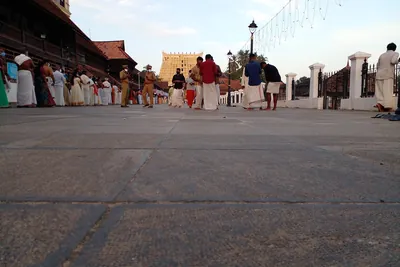
- Roads around East Fort close or become impassable on the final night. Assume you will walk the last stretch, and possibly a long one.
- Parking is not a realistic plan.
- Arrive hours early if you want a good vantage point for the lamps rather than a view of the back of a crowd.
Travelling light matters more than usual. Everything you carry has to be deposited if you go in, and managed if you do not. The full checkpoint sequence is on the temple rules page.
When the next Lakshadeepam falls
Documented recent cycles concluded in 2014 and 2020. On a six-year interval that places the following one in early 2026, and the one after that around 2032.
Treat those years as the framework rather than as booking dates, for two reasons. The exact days are set by the Malayalam calendar and announced by the temple, not derived arithmetically. And the schedule of a ritual of this scale can be affected by circumstances, as many temple calendars across India were during the pandemic years.
Before you book anything, confirm against the temple's own announcement and local reporting from Thiruvananthapuram, which carries the Murajapam and Lakshadeepam schedule well in advance. A six-yearly event is exactly the kind of thing that gets repeated inaccurately across travel sites for years after the fact.
If your dates cannot flex that far, the annual Utsavams are the reliable alternative. Both close with the Aarat procession to Shanghumugham, and both give you a lit, decorated, fully active temple without a six-year wait.
What a non-Hindu visitor can see
The entry restriction applies during Lakshadeepam exactly as it does the rest of the year, and no exception is made for the festival.
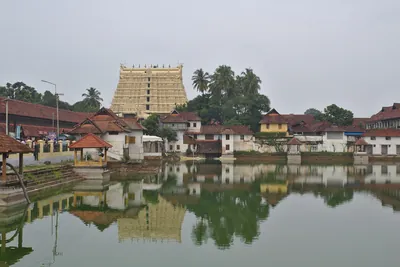
The good news is that Lakshadeepam is unusually generous to visitors who cannot go in, because much of the display is on the exterior. The lamps on the outer walls, the lit gopuram and the surroundings of the Padma Theertham tank are all outside the entry checkpoint.
That also means photography is possible, which it never is inside. Almost every well-known photograph of Lakshadeepam is an exterior shot for exactly this reason.
Pair it with Kuthiramalika Palace next door earlier in the day, and you have a full itinerary that does not depend on entering the temple at all. Our places to visit guide covers the rest.
Is it worth planning a trip around?
Yes, if you can be flexible on dates once the announcement comes, you can book accommodation months ahead, you are willing to stand for a long time in a large crowd, and you understand you are coming for a spectacle rather than for a calm darshan.
No, if your priority is time in front of the deity. On that measure Lakshadeepam is the worst night of the six-year cycle to choose, not the best. A weekday morning in the 8:30 to 10:00 AM window will always give you more.
The arrangement that gets you both: come during the Murajapam period, do your darshan on an ordinary morning early in the cycle, then stay for the final night as a separate occasion. You get the recitation, an unhurried darshan and the lamps, without trying to combine them in one evening.
If you are building the trip from scratch, start with the first-time visitor guide, which sets out arrival, dress, timing and the five-hour closure in order.
Key points to remember
- Lakshadeepam means a lakh of lamps and is held once every six years at Padmanabhaswamy.
- It is the final night of Murajapam, fifty-six days of continuous Vedic recitation performed in relays.
- Documented recent cycles fell in 2014 and 2020, placing the following one in early 2026 and the next around 2032.
- Exact dates follow the Malayalam calendar and are announced by the temple. Confirm before booking anything.
- Darshan windows shorten and shift through the cycle, and the final night is the most disrupted.
- Much of the lamp display is on the exterior, so non-Hindu visitors can see and photograph it from outside.
- Rooms near the temple go months ahead and roads around East Fort become impassable on the night.
Sources and further reading
Lakshadeepam, answered
Ten questions on the six-year cycle, Murajapam, dates and what a visitor can actually see.
What is Lakshadeepam at Padmanabhaswamy Temple?
Lakshadeepam means a lakh of lamps, one hundred thousand. It is the concluding night of the Murajapam cycle, when the temple, its corridors, walls and surroundings are lit entirely by traditional oil lamps. It is the rarest and most spectacular event in the temple's calendar.
How often is Lakshadeepam held?
Once every six years. That interval is what makes it exceptional: everything else in the temple's calendar, including both ten-day Utsavams, comes round annually. Miss Lakshadeepam and the next opportunity is most of a decade away.
What is Murajapam?
Murajapam is a cycle of continuous Vedic chanting that runs for fifty-six days inside the temple, performed by assembled scholars in relays so the recitation never breaks. The word comes from mura, meaning a turn or round. Lakshadeepam is its concluding night.
When is the next Lakshadeepam?
Documented recent cycles concluded in 2014 and 2020, which on a six-year interval places the following one in early 2026 and the next around 2032. Exact dates are fixed by the Malayalam calendar and announced by the temple, so confirm against the temple's own announcement before booking.
How many lamps are lit during Lakshadeepam?
A lakh, one hundred thousand, is the traditional count that gives the festival its name rather than an audited figure. What is not in question is that the scale is enormous and that the temple looks completely unlike its ordinary evening self.
Can non-Hindus see Lakshadeepam?
Yes, from outside. The entry restriction applies during the festival exactly as at any other time, but much of the lamp display is on the exterior walls, the gopuram and around the Padma Theertham tank, all of which sit outside the entry checkpoint. Photography there is unrestricted.
Do darshan timings change during Lakshadeepam?
Yes, substantially. Through the Murajapam period the temple runs a ritual programme that takes precedence over the ordinary darshan windows, and the final night is the most disrupted of all. The dress code and entry restriction do not relax at any point.
How crowded is Lakshadeepam?
It produces the heaviest crowds the temple sees. Accommodation in Fort and East Fort is booked out months ahead, roads around East Fort close or become impassable on the night, parking is not a realistic plan, and you should arrive hours early for any kind of vantage point.
Can I photograph Lakshadeepam?
Only from outside the temple. Phones and cameras are deposited at the cloakroom before entry and photography inside is never permitted. Almost every well-known photograph of Lakshadeepam is an exterior shot taken from outside the checkpoint, which is why they all look similar.
Should I plan my whole trip around Lakshadeepam?
Only if you want the spectacle and can accept that it is the worst night in six years for a calm darshan. The arrangement that gets you both is to come during the Murajapam period, take your darshan on an ordinary morning early in the cycle, then stay for the final night as a separate occasion.